by Roger Adamson and Peter Pyle
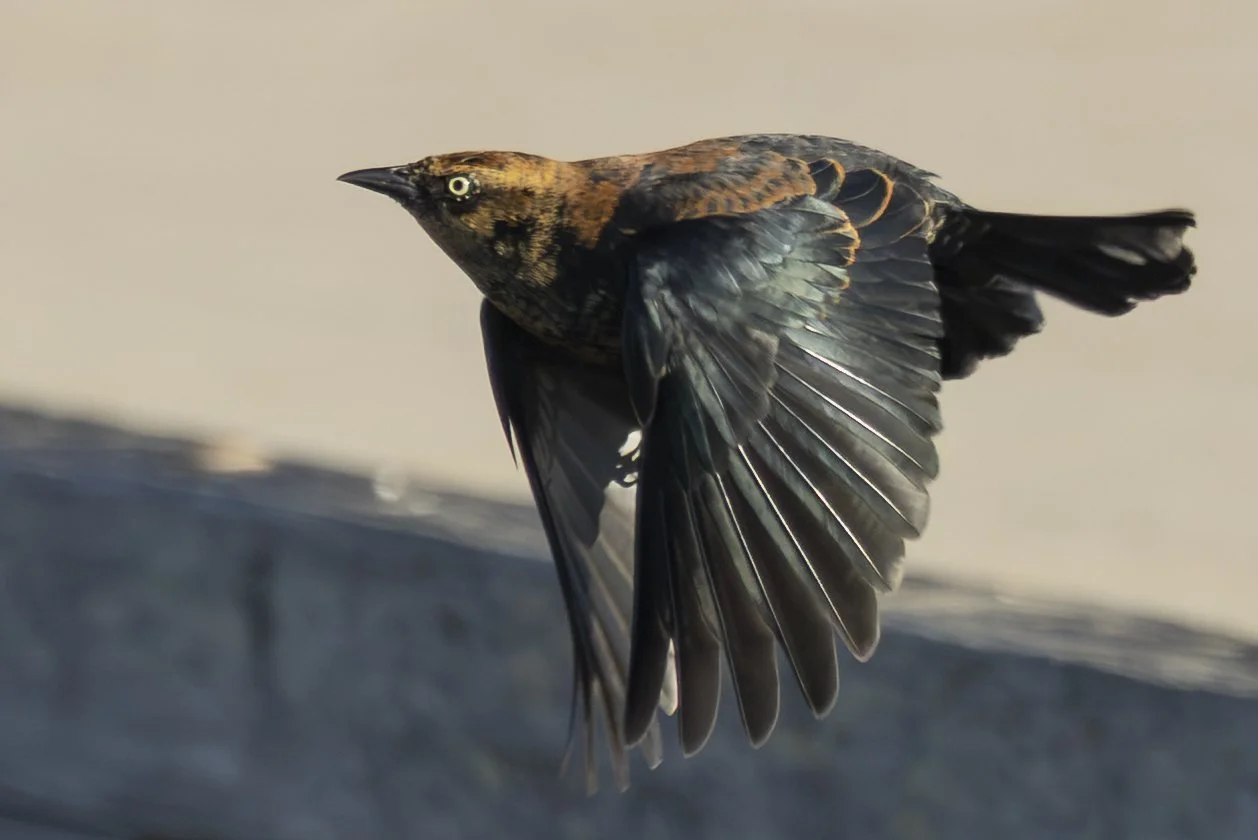
Rusty Blackbird, 10/15/2026, Laguna Point, Roger Adamson.
A small handful of species occupied our time in October, with one individual bird stealing the show. Last month we reported that Junco Bullick had found a male Rusty Blackbird at Laguna Point on 9/30. However, after nearly a week, no one had refound it, and we thought it probably had moved on. It was a shock when on 10/11, while enjoying an afternoon sea watch, a male Rusty Blackbird was seen again at the Laguna Point platform (RA). With renewed effort, the bird (we assume it was the same male, because it looked very similar and these are rare in California) was enjoyed by several birders through 10/16 (MF, CK, TB, MS, KL, KP, JL, BK, TE, FS, CV, JW). In breeding plumage, they look much like Brewer’s Blackbirds. However, this individual was a non-breeding male, with the characteristic rust-colored body feather fringing mixed with black wings and rump, set off by the strikingly yellow eye on a black mask. Fresh fall male Brewer’s can also have this fringing (which wears off, resulting in black and shiny breeding plumage), but it is browner, not as rust colored. Rusty Blackbirds breed far to the north, from Alaska across Canada and into the northeast U.S., and they typically winter in the southeast U.S. This bird was a real treat.
Several Tropical Kingbirds were seen fly-catching during the month, with the first (maybe two) reported from Point Arena on 10/1 (RT). Another was found at Caspar Pond on 10/3 (CL). On 10/9, a Tropical Kingbird was recorded near Virgin Creek (MF). Then on 10/12 and on 10/15 Tropical Kingbirds were found again at Caspar Pond (ME & LE, and EA, respectively). The latter birds seem unlikely to be the same as the 10/3 individual, so Caspar Pond should be checked regularly this time of year and through winter!
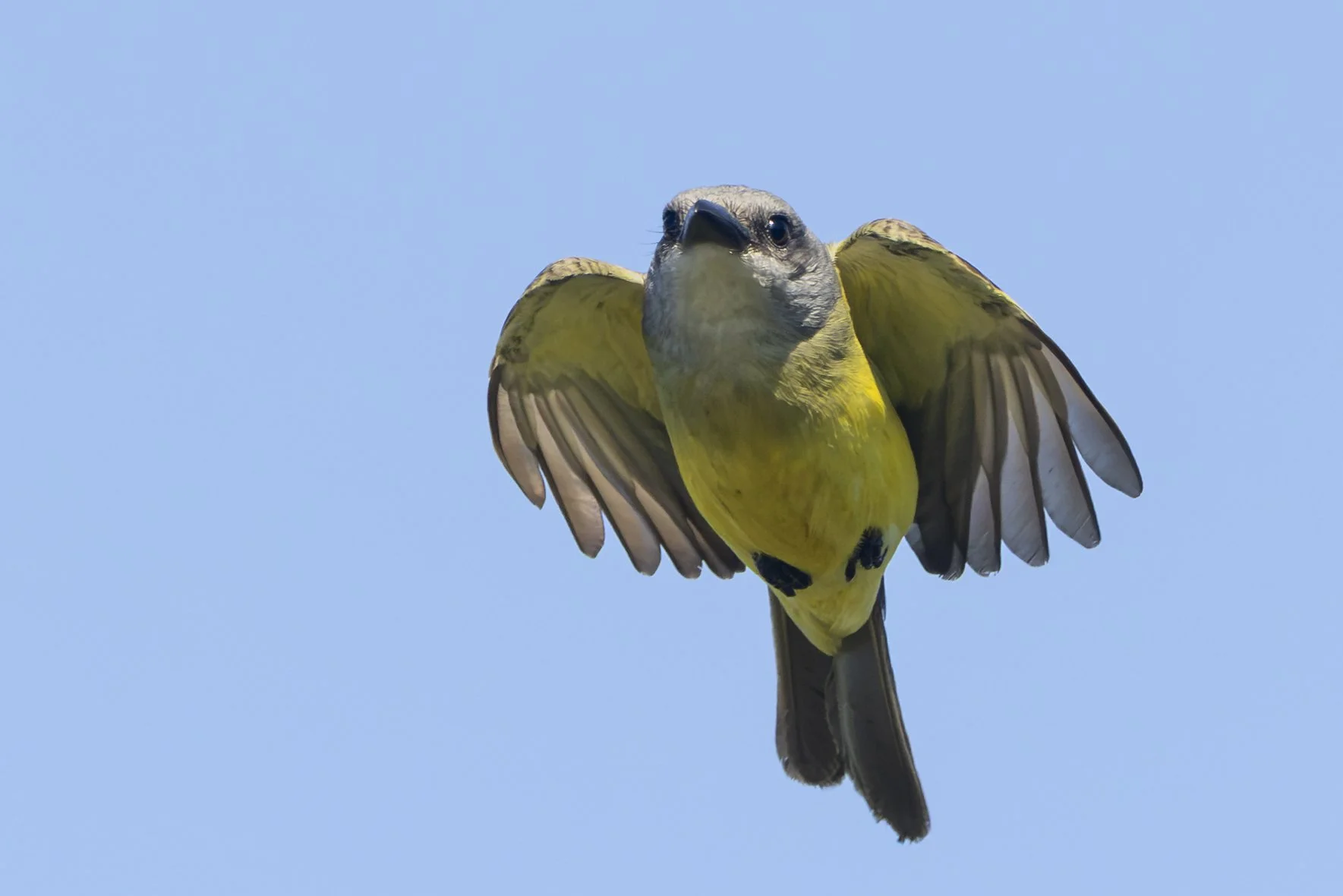
Tropical Kingbird, Caspar Pond, 10/3/2026, Roger Adamson.
August through December we often see Pacific Golden-Plovers (PAGP), with the peak in mid-October. Last month the first PAGP of this year was found on 9/25 (CL). On 10/9 at least 3 PAGP (maybe 4) were seen on the beach near Ward Avenue (PP); one of them was likely the same bird first seen on 9/25. While PAGP are not unusual and are expected this time of year, they are always a welcome and colorful addition to the list of “county-year-birds.” More exciting was the discovery of an American Golden-Plover (AMGP) on 10/2 (BK), also at Ward Avenue with a large group of roosting Black-bellied Plovers. On 10/14 the same AMGP and a second were seen also along Ward Avenue (PP) and two were still present on 10/16 (TB & CK) and 10/19 (KP) in company with at least one PAGP, very late for this species to be in California. AMGP nest across the Alaskan and Canadian Arctic. They winter primarily in the Argentine pampas. We see relatively few AMGP because their southward migration routes are most commonly along the Atlantic coast, then trans-oceanic to South America, with part of the population using Central Flyway routes to the Gulf Coast and on south from there. The AMGP we see along the California coast are thought to be chiefly from the most western populations in Alaska.
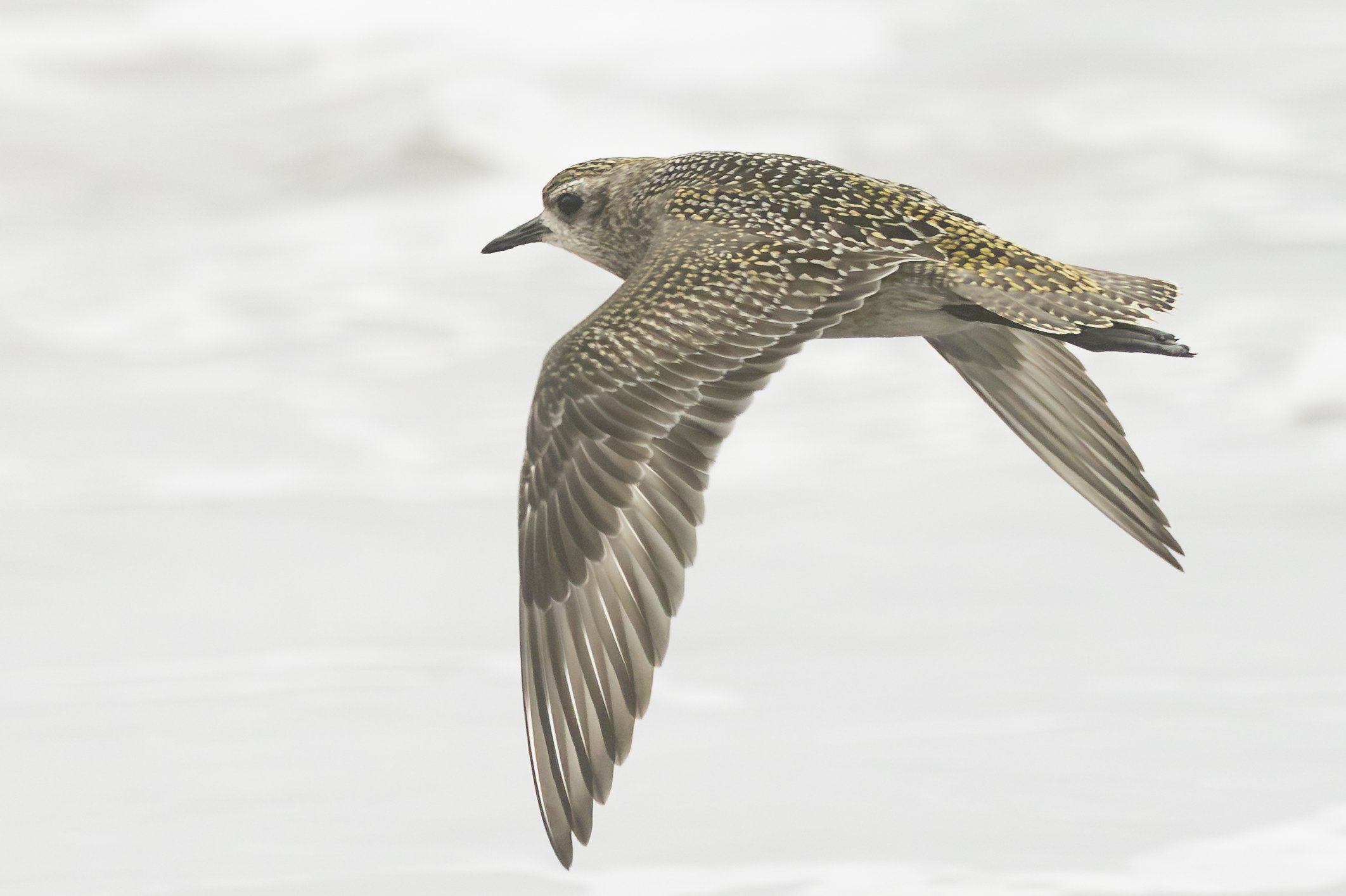
American Golden-Plover, 10/9/2026, Ward Avenue, found by Bob Keiffer, photo Roger Adamson.
Our continuing hybrid American x Black Oystercatcher was found 10/01 at Laguna Point (JB, MF, RA, PP, TB); it was first seen in January of 2022. It is undoubtedly the same individual as this is perhaps the farthest north record for such a hybrid; it frequents the same roost sites, and its plumage does not change from year to year. (We keep hoping it will become whiter with age and can be called an American! But not so far). A Clay-colored Sparrow was found on 10/6 and then two were seen on 10/7 at Usal (CD). Another Clay-colored Sparrow was reported near the entrance kiosk at Van Damme State Park on 10/11 (JM). Also, on 10/7 a Grasshopper Sparrow was reported from Big River (CD). A Tennessee Warbler (probably continuing) was noted at the Mendocino Coast Botanical Gardens on 10/11 (PP). Two, maybe more, Evening Grosbeaks were heard flying over at a home just south of Fort Bragg on 10/12 (PP), part of a montane-species invasion that has also brought unusually large numbers of Red Crossbills to the coast during the last three weeks of October. At least 25 (maybe 100) Black-vented Shearwaters were seen from Laguna Point on 10/15 (RA), a Lesser Canada Goose was identified at Virgin Creek on 10/18 (PP), a Long-tailed Duck was found with Surf Scoters off Ward Avenue on 10/26 (DB, MC), and a Swamp Sparrow, likely a returning wintering bird, was heard in the Ten-mile River marshes on 10/29 (PP).
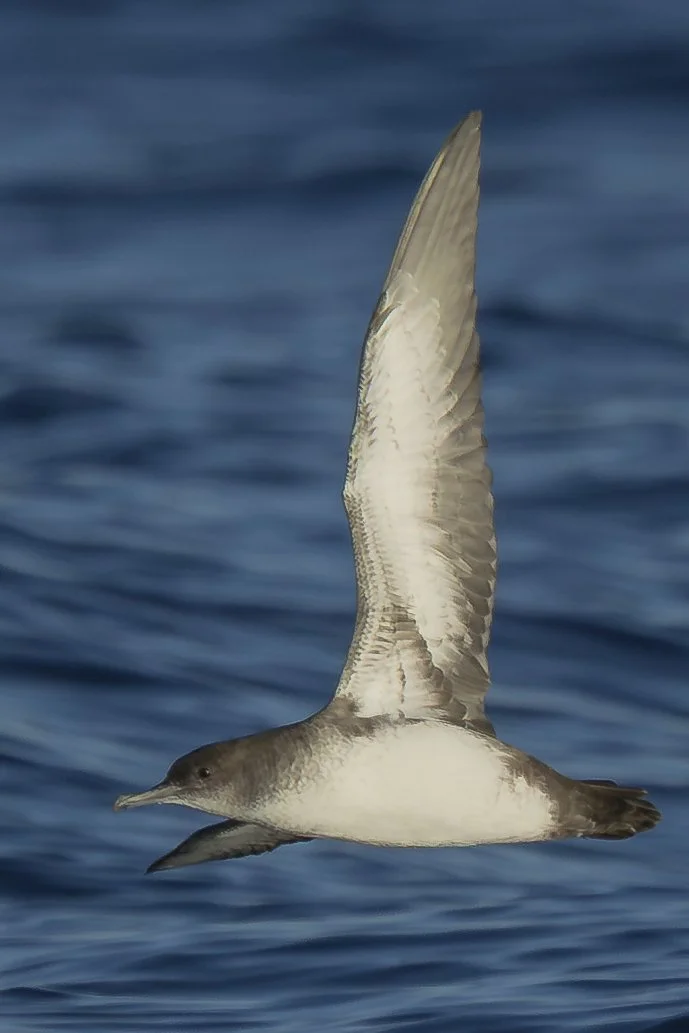
Black-vented Shearwater, 10/17/2026, Roger Adamson.
Lastly, we should note the results of the pelagic trip on 10/17. For the third month this year, we found Black Storm-Petrels, rarely seen before this year. On this trip we had “only” 23. Two Laysan Albatrosses, in addition to over 100 Black-footed Albatrosses, delighted all on board. In contrast to earlier in the year when Sooty Shearwaters are common, this time we had under 100 Sooties, while we spotted over 500 Pink-footed Shearwaters. There was one Flesh-footed Shearwater that came in close enough for good photos and one Manx Shearwater that made a very rapid pass and was seen by only a few participants. The startling surprise was seeing nearly 1400 (!) Black-vented Shearwaters. This species breeds off Mexico and is usually only seen from Monterey south to Central Mexican waters when at sea. This year, probably due to the developing El Niño, they (along with the boobies of the last two months) are foraging further north, looking for cooler, more productive water.
This article covers the period October 1 through October 30. Thanks to all who reported sightings: Junco Bullick (JB), Roger Adamson (RA), Matt Franks (MF), Catherine Keegan (CK), Tim Bray (TB), Mark Schwartz (MS), Keith Leland (KL), Karen Pinckard (KP), John Luther (JL), Bob Keiffer (BK), Todd Easterla (TE), Fritz Steurer (FS), Chuck Vaughn (CV), Jerry White (JW), Rich Trissel (RT), Chris Lamoureux (CL), Mark Elness (ME), Lorna Elness (LE), Eric Austin (EA), Peter Pyle (PP), Cedric Duhalde (CD), John Myles (JM), Dave Bengston (DB), Mike Curry (MC).