by Joachim Gonzalez
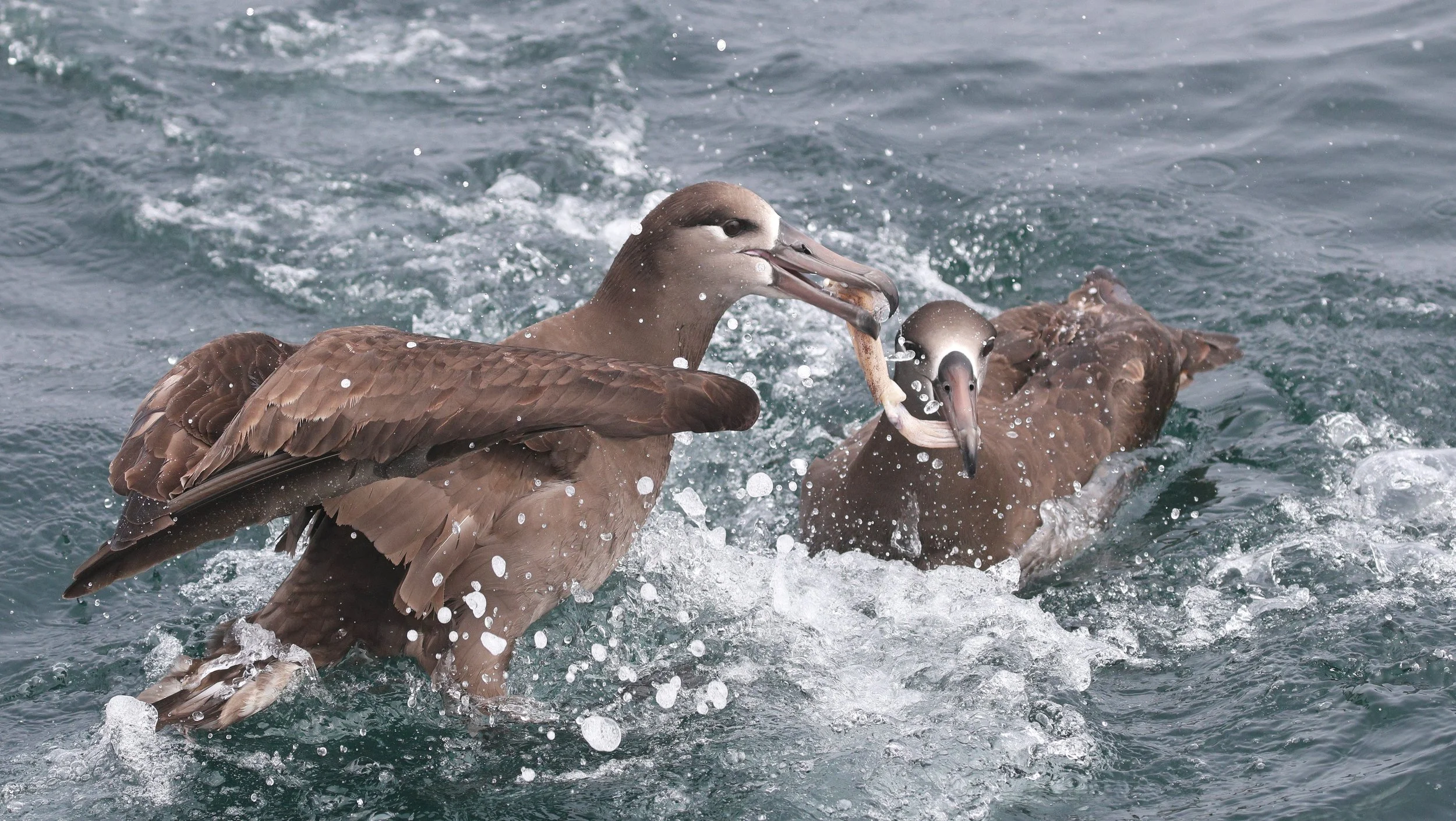
Black-footed Albatross eating a squid, photo by Tim Bray.
Spending twelve hours offshore on a pelagic birding trip gave me a perspective on my research that I cannot get from a computer screen or a laboratory bench. My current work focuses on sequencing the entire genome of the Waved Albatross, Phoebastria irrorata. During the trip, I had the opportunity to observe one of its close relatives, the Black-footed Albatross, in its natural environment. Seeing these birds flying and foraging over the open ocean made the connection between my research and the living organisms behind the DNA much more tangible. Much of my work involves thinking about the Waved Albatross at the molecular level: extracting and sequencing DNA, assembling a genome, and eventually using that genomic information to better understand the species. The Black-footed Albatrosses I encountered on the trip reminded me that a genome is more than a sequence of nucleotides. It is a record of an organism’s evolutionary history and its adaptations to the environment in which it lives. Albatrosses are particularly remarkable examples of this relationship. Their ability to travel enormous distances across the ocean and efficiently use wind energy is closely connected to their ecology and evolutionary history. Research on Phoebastria species has shown that differences in morphology and flight performance are associated with the wind and ocean environments they inhabit.
The trip also made me think about why obtaining a high-quality genome is valuable. Genomic comparisons among closely related species can help researchers understand how different evolutionary histories and environments have shaped their biology. In fact, recent whole-genome research on North Pacific albatrosses has used genomic data to investigate their evolutionary relationships, demographic histories, genetic diversity, and possible adaptations. My work on the Waved Albatross contributes to this broader effort to understand albatross evolution through their genomes.
Most importantly, the experience helped connect two parts of my scientific interests: field biology and molecular biology. Before the trip, the Waved Albatross was primarily a genome that I was working to sequence and understand. Seeing a close relative of the species in the open ocean gave me a greater appreciation for the organism that my research ultimately represents. The experience reinforced my interest in using molecular tools to answer questions about real organisms, their evolutionary histories, and their relationships with the environments they inhabit.